
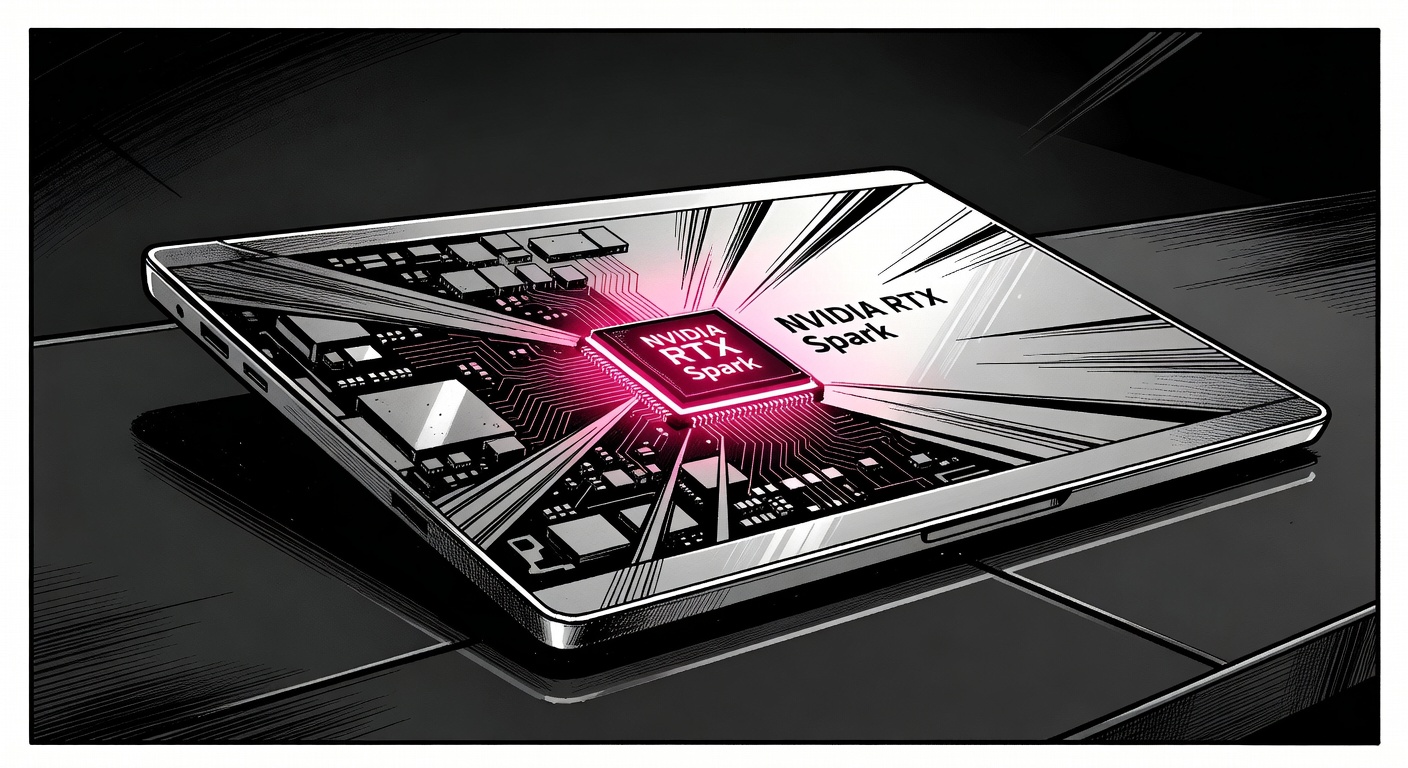
NVIDIA just ended the 30-year era of “CPU + separate GPU” PCs.
In a keynote that felt more like a paradigm shift than a product launch, NVIDIA revealed the RTX Spark — its first dedicated chip designed specifically for personal computers. It’s not another discrete GPU. It’s a complete System-on-Chip: ARM CPU (Grace architecture, co-developed with MediaTek), Blackwell-class RTX GPU, and up to 128GB of unified memory, all on a single 3nm silicon die.
The headline number that matters most: 1 petaflop of local AI performance.
What This Actually Means for AI
This isn’t just “faster inference.” This is the moment local AI stops being a gimmick and becomes genuinely useful.
-
120-billion-parameter models running entirely on your laptop — no cloud, no API keys, no data leaving your machine. We’re talking real-time, always-on personal agents that can reason, code, edit video, and maintain long-term context without ever phoning home.
-
Privacy and sovereignty by default. For anyone who has been uncomfortable sending sensitive work, personal conversations, or proprietary code to OpenAI/Anthropic/Google, this changes the equation. The model lives on your silicon.
-
Continuous agent operation. A 1 petaflop NPU-class accelerator inside a thin 14mm laptop means you can finally run persistent agents 24/7 without destroying battery life or needing a desktop rig. The “personal AI teammate” narrative stops being marketing and starts becoming technically feasible.
-
Zero-copy unified memory changes the game. With CPU, GPU, and AI accelerator sharing the same memory pool (up to 128GB), we eliminate the massive data movement tax that currently bottlenecks multimodal models and agent workflows. This is the same architectural advantage Apple Silicon has had — except now it’s paired with NVIDIA’s full CUDA + RTX software stack on Windows on ARM.
The Bigger Picture
For years, the AI industry has been split between two worlds:
- Massive cloud models (powerful but centralized and expensive)
- Small on-device models (private but limited)
RTX Spark collapses that distinction. It brings datacenter-class local inference into a form factor that can actually fit in a backpack. When major OEMs (Dell, HP, Lenovo, ASUS, even Microsoft Surface) start shipping these this fall, the baseline expectation for a “good laptop” will include the ability to run frontier-class models locally.
This also accelerates the “AI PC” narrative that Microsoft and others have been pushing — but this time the hardware is actually there. Windows on ARM finally gets a credible high-performance reason to exist.
Gaming Is Just the Cherry on Top
The demo showed Forza Horizon 6 and 007: First Light running at 100 FPS in 1440p on battery with no throttling. Impressive, but secondary to the AI story. The real unlock is that the same silicon powering those games can simultaneously run your local coding agent, image generator, or research assistant without context switching or performance cliffs.
Watch the Announcement
This is the kind of hardware that makes the agentic future feel less like science fiction and more like an upcoming software update. The question is no longer “can I run a powerful model locally?” — it’s “what kind of agent do I want living on my machine 24/7?”
The personal computer just got its second brain. And this time, it’s staying private.