
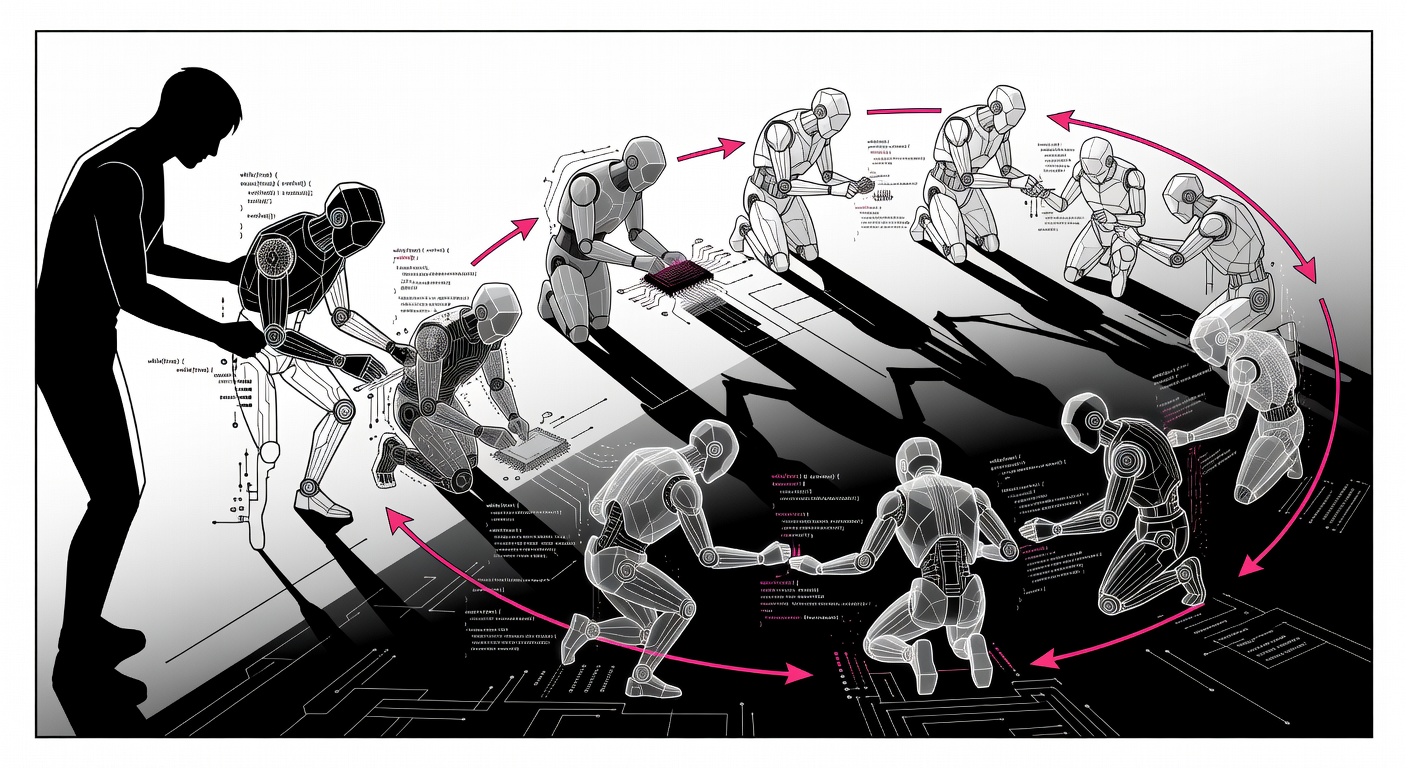
For years, the AI development loop was straightforward: humans wrote the code, ran the experiments, and iterated. That loop is changing fast.
Anthropic’s latest piece from their Institute walks through the shift toward recursive self-improvement — the point where AI systems can meaningfully design and improve their own successors. We’re not there yet, but the trajectory is clear from both public benchmarks and internal data.
The acceleration is measurable
One striking number: Anthropic engineers are now shipping 8× more code per quarter than they were in the 2021–2025 period.
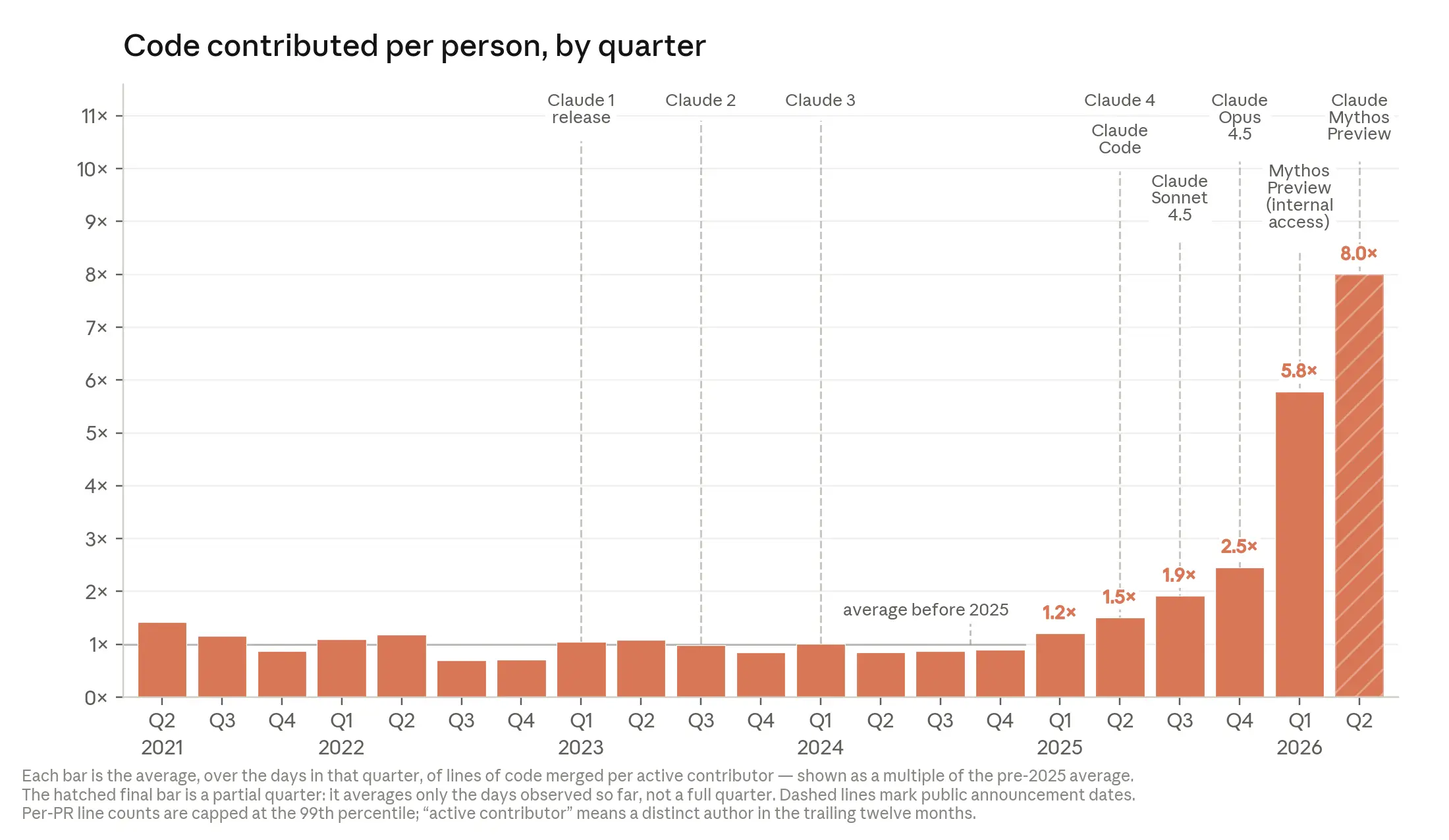
Source: Anthropic Institute – “When AI builds itself” (2026). The chart marks major model releases and shows the sharp rise in output.
This isn’t just productivity theater. It’s the result of moving from chatbots that suggest snippets → coding agents that edit files → autonomous agents that run code, delegate work, and close loops for hours at a time.
Task capability is growing fast
Public benchmarks tell a similar story. Task length that models can reliably handle has been doubling every ~4 months. The same pattern shows up in real internal measurements of agent performance:
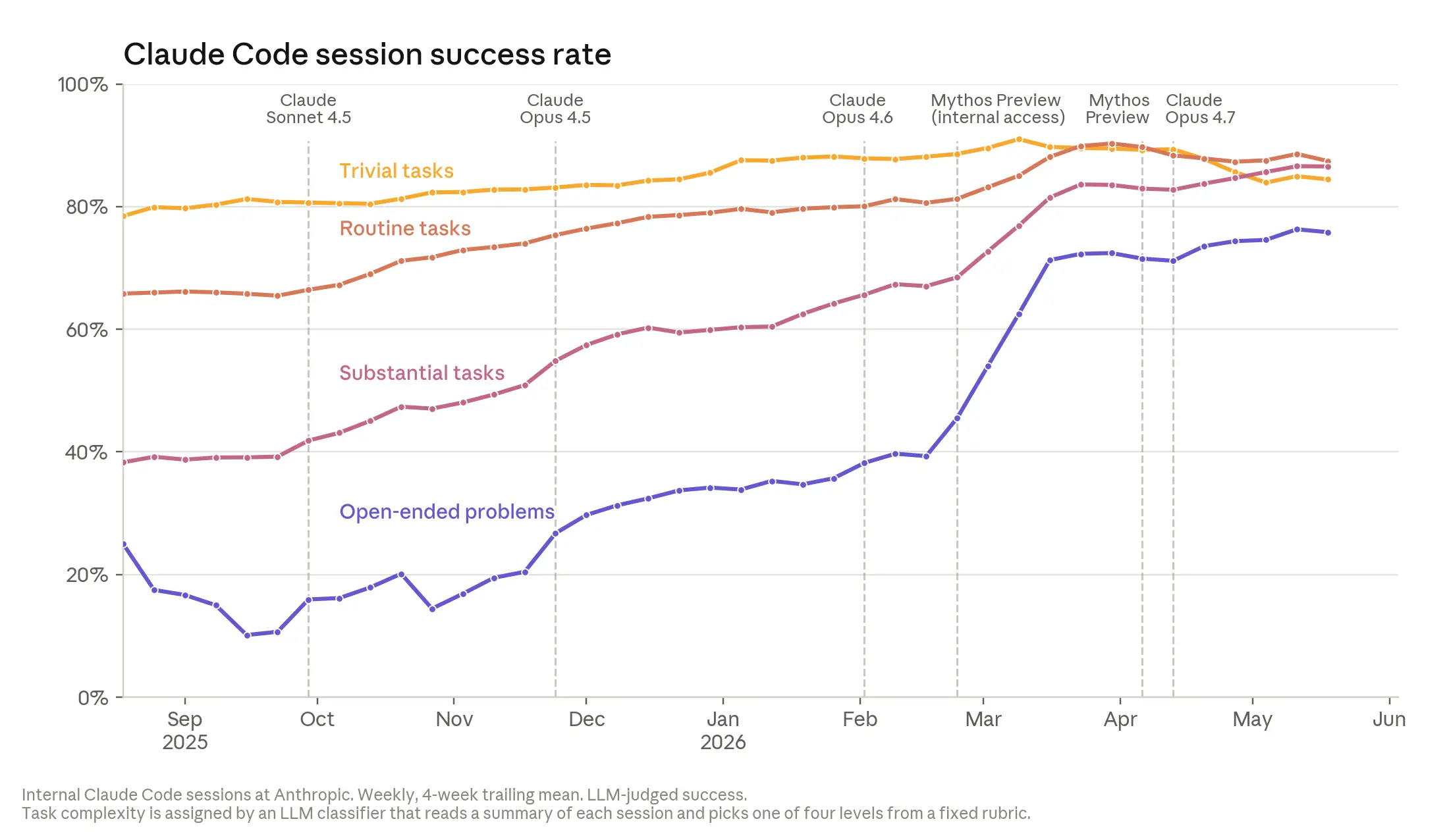
Source: Anthropic. Success rates on trivial → open-ended problems across recent Claude model families.
SWE-bench (real-world software engineering on actual codebases) went from low single digits to saturation in roughly two years. CORE-Bench (reproducing published research) went from ~20% success to saturation in 15 months.
The development loop evolution
Anthropic also shared a clear visual of how their own workflow has changed over time:
- 2021–2023: Humans + laptops (classic software engineering)
- 2023–2025: Humans + chatbots (copy-paste assistance)
- 2025–2026: Humans + coding agents (agents write and edit significant portions)
- Today: Humans + autonomous agents (agents run experiments, delegate to other agents, and sustain long-running work)
- Future (20XX?): Closing the loop — agents that can train and improve models themselves
The last step is the one that turns “AI helps build AI” into true recursive self-improvement.
Why this matters beyond hype
The upside is enormous. Faster scientific discovery, better tools for healthcare and engineering, and compounding progress on hard problems. But the risks scale too. If a system can build its own successor, the questions of alignment, monitoring, and control become much harder to answer after the fact.
Most institutions are still thinking in terms of the old development loop. The data suggests the window for thoughtful preparation is shorter than many assume.
What this means for builders right now
For those of us working with agents today, the practical takeaway is simple: the leverage is increasing rapidly. The difference between what a skilled engineer + strong agent setup can ship versus what was possible even 12 months ago is massive.
The organizations that treat agents as first-class members of the development team (not just fancy autocomplete) are already pulling ahead. The gap will only widen as the models get better at longer-horizon work.
Anthropic’s piece is worth reading in full — it’s one of the more data-rich, less speculative takes on where this is headed.
What part of this acceleration are you seeing in your own work?