

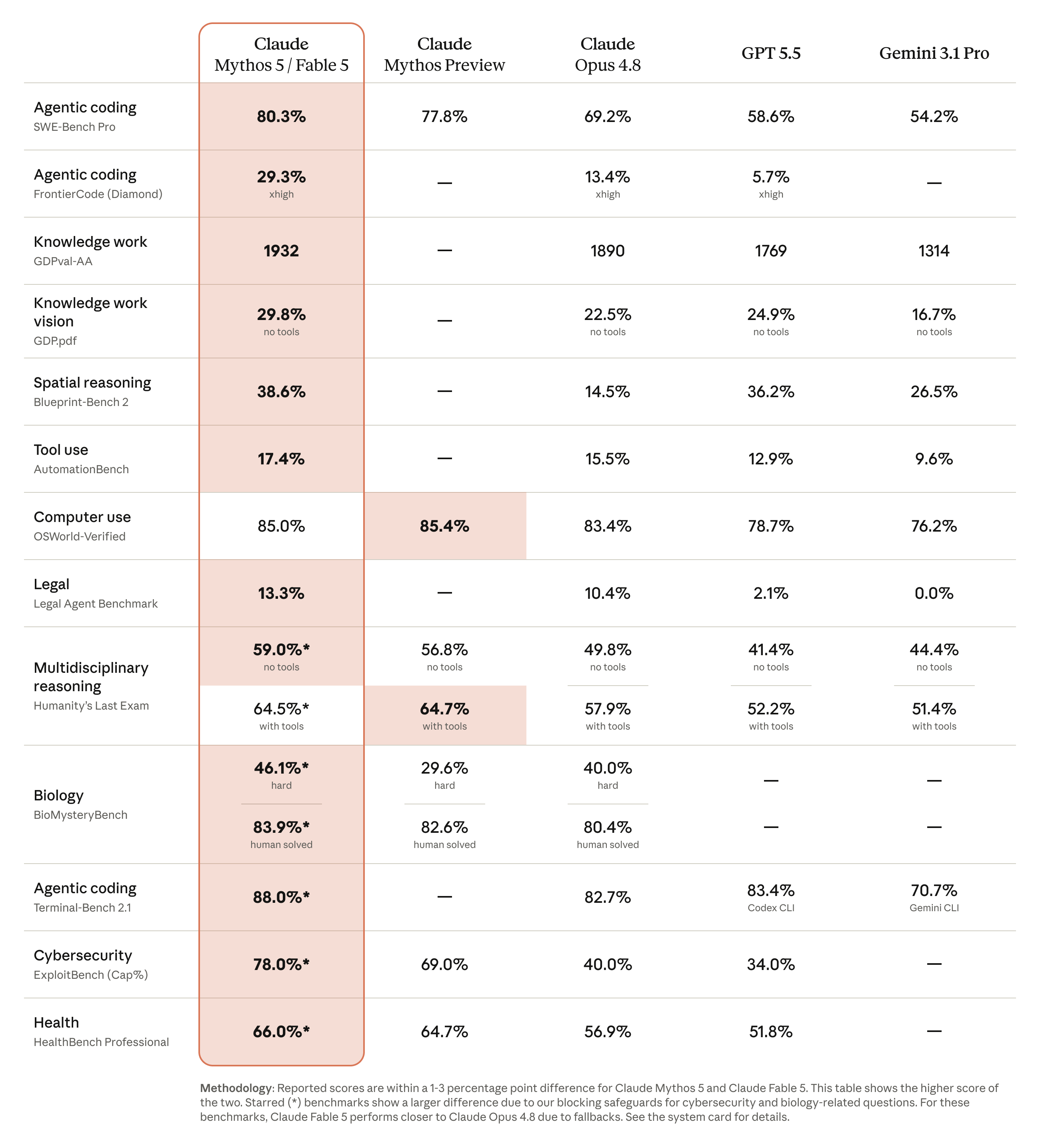
Anthropic just released Claude Fable 5 — the public, safety-mitigated version of their new flagship Mythos 5 model. It launched today (June 9, 2026) and is already being called one of the most significant capability jumps in recent months.
What actually changed
Fable 5 runs on the same base weights as the full Mythos 5 but routes dangerous or dual-use queries (cyber, bio, chem, etc.) to Claude Opus 4.8 instead. This is the exact split that had been circulating in recent leaks.
Early reports highlight:
- 1M token context window
- Major gains in long-horizon coding and agentic workflows
- Strong SOTA results on coding and knowledge-work benchmarks
- Available now on Claude.ai (paid plans), API, and AWS Bedrock
What people on X are saying right now
The reaction has been notably more grounded than typical model launches. Here are some of the more interesting takes circulating today:
- Andrej Karpathy described it as a “major-version-bump-deserving step change” that feels qualitatively different on ambitious, long-running tasks.
- One engineer shared that Stripe reportedly migrated 50 million lines of code in a single day using the new model — the kind of scale that usually takes teams weeks.
- Multiple developers noted it excels at sustained agentic loops and complex reasoning chains where previous models would lose coherence.
- The “Fable vs Mythos” naming split is being discussed as Anthropic’s way of offering a safer public model while keeping the less-restricted version for vetted partners (Project Glasswing).
The overall sentiment feels different from the usual hype cycle. People aren’t just posting benchmark numbers — they’re sharing concrete production stories and workflow changes.
Why this matters for agents
For anyone building agents, the jump in long-horizon reliability is the real story. Previous models could handle short bursts well but often degraded on multi-hour or multi-day tasks. Early signals suggest Fable 5 maintains coherence and tool-use quality over much longer sessions.
The 1M context also changes how we can structure agent memory and retrieval — less need for aggressive summarization or chunking strategies.
Bottom line
Claude Fable 5 feels like the first model in a while that meaningfully moves the needle on what’s actually possible to delegate to an agent in production. Not just incremental benchmark gains, but a qualitative shift in how far you can push a single thread of work.
I’ll be testing it heavily over the next few weeks on some of the more complex automation patterns I’ve been exploring. Early access on Claude.ai is available now if you have a paid plan.